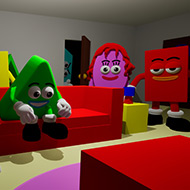









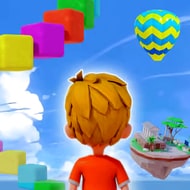
What happens when the stair you lined up your jump for simply is not there anymore? That question sums up the learning curve of Colorup better than any list of controls could. The town looks cheerful, all bright rooftops and floating festival balloons, but the moment a staircase you expected to land on turns out to be a gap, the game stops being a stroll and starts demanding real attention.
| Genre | Platformer, parkour-style stair jumping |
| Core mechanic | Jumping across blocks and stairs of varying heights through a town |
| Setting | A colorful town during an ongoing festival, with hot air balloons overhead |
| Controls | Arrow keys to move, Shift to accelerate |
The basic loop in Colorup asks for less than it looks like at first glance: move with the arrow keys, hold Shift when a straightaway opens up, and time each jump to land on the next block instead of the gap beside it. What complicates that simple loop is the town itself. Stairs are not all built the same way, and several types only reveal themselves once a player is already mid-jump, which means committing to a landing spot on faith rather than certainty.
New players tend to treat every staircase in Colorup like the first few, assuming a visible edge means a safe edge. That assumption breaks quickly once hidden stairs start appearing without warning, tucked behind rooftops or timed to shift a beat after they come into view. The town rewards players who slow down and actually watch a stair’s behavior for a moment before committing, rather than players who jump on reflex the instant a platform appears on screen.
Speedrunners chasing a clean run through Colorup talk about this tension constantly. Holding Shift to cover ground faster is the whole appeal of the movement, but every extra bit of speed shrinks the window to notice a stair that is about to vanish or shift underneath a landing.
By the time a run reaches the festival’s more built-up rooftops, the game has usually introduced every stair type it plans to use. From that point on, the challenge is less about learning new tricks and more about executing familiar ones under tighter timing.
Combo Jump is the reward system sitting underneath everything else in Colorup. Landing three consecutive stair jumps without a stumble triggers it, giving the next jump noticeably more height and distance than a standalone hop would manage. Once a player internalizes this, movement through the town stops being jump-by-jump and starts being planned in chains of three.
Color Orbs are scattered through the town, usually positioned just off the direct path between one stair and the next. Grabbing them mid-run without breaking stride is one of the clearer signs of a player who has moved past treating Colorup as a simple obstacle course, since collecting an orb cleanly usually means altering a jump’s arc rather than detouring for it.
Hidden stairs are the mechanic players argue about most in comments and forum threads. Some treat them as the game’s best idea, since they force real attention instead of memorized muscle memory. Others find them close to unfair on a first attempt, since there is no visual tell before the first stair vanishes under a player’s feet, and losing a Combo Jump chain to a stair that was never really there is the single most common complaint about the town’s later sections.
Momentum carries between jumps in a way that is easy to miss early on. A jump taken right after Shift-accelerating covers noticeably more ground than the same jump taken from a standing start, which is why practiced players rarely release Shift mid-chain even when a stair looks close enough to reach without it.
Early in the game, Colorup’s stairs sit close together and rarely hide anything, which is exactly why the jump from those opening rooftops to the festival’s denser skyline catches so many players off guard. Once hot air balloons start drifting into the background and the rooftops narrow, the game starts combining hidden stairs with tighter Combo Jump windows, so a single misread costs both a landing and a combo chain at the same time.
Casual players who only want to see the town tend to stick to the wider, well-lit rooftops where stairs behave predictably, while players chasing every Color Orb push into the narrower festival sections where a missed jump usually means restarting a whole stretch. Both approaches are valid ways to play Colorup, but they produce very different experiences of the same town.
The festival atmosphere is not just decoration. Hot air balloons occasionally drift low enough to block the view of an upcoming stair for a half-second, and while that overlap is brief, it lines up often enough with hidden-stair placements that experienced players treat a balloon crossing overhead as a cue to slow down rather than a cosmetic detail.
By the time a run reaches the puzzles numbered in the high twenties, the kind of stretch players screenshot as proof of reaching Puzzle 28 and beyond, the game is asking for the full skill set at once. That means reading stairs on faith, holding Combo Jump chains through narrow gaps, and still detouring for orbs without breaking either.
Colorup ends up being a much sharper game than its cheerful rooftops and drifting balloons suggest. Once hidden stairs start punishing reflex jumps instead of rewarding them, the players still climbing past Puzzle 28 are the ones who learned to read the town instead of trusting it.