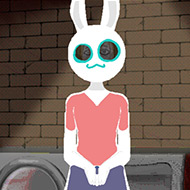









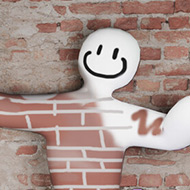
The Spoid tool in MECCHA CHAMELEON doesn’t just sample colors — it’s the entire difference between blending into a wall and getting shot by an Oni within the first ten seconds of a round. Every match starts the same way: you’re a featureless, pure-white bipedal chameleon with nothing to hide behind, and the paint you apply to your own body is the only disguise the game gives you. No prop transformations, no preset costumes, just a brush and whatever surface you decide to copy.
The Spoid is an eyedropper: point it at a nearby surface and it pulls that exact color onto your palette so you can paint it onto your own chameleon body. Sounds simple, but the game punishes flat, single-color paint jobs almost immediately — a wall isn’t one shade, it’s a base tone plus shadow lines plus texture noise, and an Oni’s eye catches a flat patch of color faster than an imperfect but layered one.
Most new players paint themselves once, pick a corner, and hope. Regulars build up layered coats during the preparation phase, sampling a shadow color from a nearby doorframe or a highlight from a windowsill, and that extra thirty seconds of layering is usually the difference between surviving to the timer and getting picked off in the first sweep.
Painting badly isn’t really a failure state early in the game — it’s how everyone starts. The skill curve here is steep enough that a player’s first few matches almost always end quickly, and that’s expected rather than a sign something’s broken.
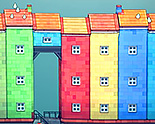
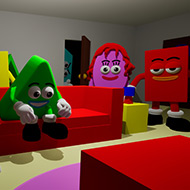
MECCHA CHAMELEON rotates between several distinct maps, including a Farm setting, a Home interior, a Halloween-themed map, and a Party map, and each one rewards a different painting approach. A cluttered Farm shed gives you dozens of small objects and color transitions to hide among, while an open Home hallway forces you to commit to one wall texture and hold still.
Experienced players scout a map’s prep phase specifically for spots where the surrounding texture already does half the disguise work — a shelf full of mismatched clutter hides an imperfect paint job far better than a clean, single-color wall does.
Paint alone doesn’t sell a disguise; MECCHA CHAMELEON also gives Hiders a pose set — curling into a ball, crouching low, lying flat, or pressing directly against a wall — and matching a pose to a nearby object matters as much as color accuracy. Curling up near a stack of balloons at the Party map reads as another balloon at a glance; standing upright in the open reads as exactly what it is.
Ask around and the same gripe surfaces constantly: the paint brush’s resolution isn’t fine enough for genuinely detailed work. Trying to trace a straight edge or a thin shadow line often comes out pixelated instead of clean, which caps how convincing a disguise can get no matter how much time you spend on it during prep.
The other honest criticism is about how public lobbies actually play out. In theory MECCHA CHAMELEON rewards creative, surface-matched camouflage, but in a lot of public matches Hiders default to crouching in dark corners rather than painting anything elaborate — the artistic side of the game is easy to skip entirely if your teammates aren’t pushing each other to bother with it.
What keeps Hiders alive until the timer hits zero in MECCHA CHAMELEON was never about vanishing completely — it’s about making an Oni hesitate over whether that oddly-posed shape near the balloons is really a balloon, and that half-second of doubt is the whole game.