









A Little to the Left looks like a tidy simulator where you line up soap bottles and stack towels, but it plays like a lateral-thinking puzzle wearing chores as a disguise. Every cluttered shelf, drawer, or windowsill hides a specific, deliberate arrangement, and figuring out what that arrangement wants from you turns out to be far more interesting than just making a mess look neat.
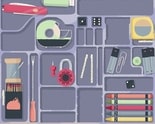
Every puzzle starts as visual noise — pencils scattered across a desk, eggs piled into a carton, stickers slapped onto a page with no apparent order. Dragging and dropping is the entire input method, but the objects themselves supply the logic: they slot into place, align edge to edge, or click into a satisfying arrangement once you’ve found the configuration the level actually wants. Nothing is explained up front, which is deliberate — working out the rule of a given puzzle through trial and error is most of the appeal of this game.
Beginners tend to assume there’s exactly one correct layout and get stuck hunting for it, when many puzzles quietly accept more than one valid solution. A stack of books might sort correctly several different ways:
The game rewards whichever version actually clicks into place, rather than the version you assumed was intended from the start.
This flexibility is the mechanical heart of the puzzle design. Rather than presenting one rigid target, most levels have several valid end states, and part of the fun is stumbling into an arrangement you didn’t plan for and realizing it counts. Players who go back through solved puzzles specifically to find an alternate valid layout tend to get the most out of it, since the combo challenges built into many levels only reward the more deliberate or unusual arrangements rather than the first one you land on.
A cat named Rookie lives in the spaces these puzzles take place in, and Rookie is not a passive presence. He grabs pieces mid-solve, drags objects out of position, and swipes a tail across an arrangement you’d just finished. It’s a genuinely divisive detail among players — some find Rookie’s interference charming and true to how a real cat behaves, others find it actively frustrating when it undoes a fiddly puzzle they’d just nailed. Either way, it’s one of the few puzzle games where the antagonist is a specific, named animal rather than an abstract difficulty setting.
The base game moves through multiple chapters, starting with everyday living-room and office clutter before shifting into kitchen-themed puzzles under the Lost Recipe chapter, where the objects and their logic change accordingly — ingredients, cookware, and pantry items replace stationery and knickknacks. Later chapters and paid expansions add new physical behaviors on top of the drag-and-drop base, including folding, crushing, and stacking objects in ways earlier puzzles never asked for.
Two expansions in particular, Cupboards and Drawers and Seeing Stars, layer close to forty additional puzzles onto the same foundation, pushing the same core idea — find the arrangement the level wants — into new physical contexts without changing what’s actually being asked of you.
Outside the main chapters, there’s a rotating puzzle called the Daily Tidy Delivery, a fresh arrangement delivered once a day that plays like a quick check-in rather than a full session. Puzzles from past seasonal events — Christmas, Easter, and Halloween arrangements among them — don’t disappear once their event ends; they move into a permanent Puzzle Archive, so players who missed a themed rotation the first time around can still solve it later.
Over a hundred puzzles exist across the base game and its expansions, and the difficulty curve is more about attentiveness than reflexes — nothing here is timed, and a hint system exists for anyone stuck on a specific arrangement. There’s also a quiet escape hatch called Let It Be, which lets you skip an optional puzzle entirely rather than get stuck on it, an acknowledgment that not every arrangement clicks for every player. That combination — patient puzzles, an interfering cat, and a system that doesn’t punish you for skipping — is what keeps things feeling more like a curiosity cabinet than a checklist.
Over a hundred across the base game and its chapters, with two expansions — Cupboards and Drawers and Seeing Stars — adding close to forty more between them.
Rookie interferes directly with your solved puzzles, grabbing objects, dragging them out of place, or swiping a tail across a finished arrangement, which some players find charming and others find genuinely annoying.
Yes, alongside a skip option called Let It Be for players who’d rather move past a puzzle that isn’t clicking than force a solution.
What makes A Little to the Left worth returning to daily isn’t the tidying itself — it’s the small jolt of finding out Rookie has undone your careful egg-carton arrangement again, and having to figure out, once more, what the level actually wants from you.