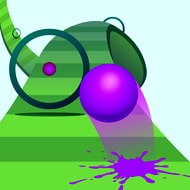
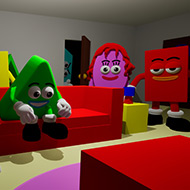









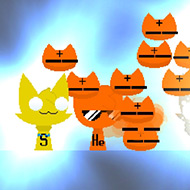




Nothing in Roly Poly Roundup responds to a key press — the cursor is the only tool you get, and every round character on screen reacts to where that cursor bumps into them rather than to any button you hold down. That one restriction shapes the entire game: herding is done by nudging, never by grabbing.
The setup is simple to state and trickier to execute: round, roly-poly characters scatter across the play area, and moving the mouse close enough to one sends it rolling in whatever direction the bump pushes it. There’s no click-and-drag, no direct control — every bit of movement the roly polies make is a side effect of your cursor’s own path through the space.
New players tend to chase individual roly polies directly, which usually scatters the rest of the group further instead of gathering anyone. The physics reward a wider, slower sweep that nudges several at once toward the same corner, rather than a fast dash after whichever one happens to be closest.
Because the collisions are physics-based rather than scripted, no two attempts push the roly polies the same way twice. A bump that gathers three of them cleanly on one try can just as easily send them bouncing off each other in the wrong direction on the next, which keeps even a short round from feeling like a solved pattern.
The goal is getting the scattered roly polies collected into a single target area, and the game leans on a hat as that destination — nudging the group toward it rather than sweeping the whole play field at once tends to work better, since chasing stragglers across open space usually just scatters the ones you already had close together.
Players who’ve spent more time with the physics start working the edges of the play area, using the boundary itself to stop a roly poly from bouncing away rather than trying to out-position it with the cursor alone. That’s the closest thing the game has to an advanced technique, since there’s no upgrade system or unlockable ability to lean on instead.
The pixel art keeps everything readable even when several roly polies are bouncing at once, which matters more than it sounds — a physics-based herding game with cluttered visuals would make it hard to tell which nudge actually worked, and Roly Poly Roundup mostly avoids that problem by keeping its cast small and its play area uncluttered.
Roly Poly Roundup doesn’t ask for much beyond a steady hand and a willingness to let physics do the work — just a cursor, a scattering of roly polies, and a hat waiting to be filled one imprecise nudge at a time.