











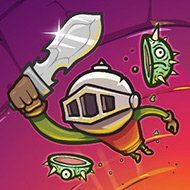
You slam your sword into a bat mid-swing, the impact launches your knight another few meters upward, and somewhere below you the lava that’s been chasing your whole run climbs one floor closer. That’s Knightmare Tower in a single moment: an upward-scrolling brawl where every kill doubles as a jump, and stopping to think is how runs end.
The core loop sounds strange until you’ve played it: your knight is always falling, and slashing an enemy on the way down converts that fall into a launch back up. Chain enough hits together and you barely touch the tower floor before you’re airborne again, dodging bats, slimes, and armored enemies that force you to change your timing mid-combo. Miss too many swings and you drop, and dropping far enough means landing in the rising lava that ends the run outright.
New players consistently make the same error: they treat the sword as the only tool available and ignore the rockets that appear periodically through a run. Riding one launches you past a whole stretch of the tower in seconds, but only if you commit to grabbing it instead of trying to squeeze in one more slash first. The game punishes hesitation far more than it punishes aggression.
Over fifty different monsters populate the tower, and the escalating difficulty comes mostly from which of them you’re facing and how the background changes around you, rather than from distinct level layouts. That’s a structural choice some players bring up as the game’s biggest limitation — runs can start to feel similar stretch to stretch even as the threat gets more real.
Ten princesses wait to be rescued, all daughters of the same king, and reaching each one means climbing measurably farther than the last. Seventy separate quests run alongside that main climb, nudging you toward specific playstyles — surviving without taking damage for a stretch, killing a set number of a particular enemy, or reaching a given height using only rocket boosts.
Gold collected mid-run funds a permanent upgrade shop between attempts. The main categories are:
Less obvious is the luck stat, which quietly raises how often monsters drop gold and potions rather than doing anything flashy. Players chasing long survival-mode runs tend to prioritize it early, since a run that’s short on potions falls apart the moment a tough enemy pattern shows up. Completionists going for every princess in one story clear usually lean the opposite direction, dumping early gold into armor and sword upgrades instead.
Special horns found through the climb summon one of three legendary monsters — optional, much tougher fights that reward better loot than the standard fifty-plus roster. Skilled players hunt these deliberately for their potion drops before pushing toward the epic boss waiting at the top of story mode, a fight that all but requires having potions saved up rather than spent earlier on regular enemies. Speedrunners chase a separate goal entirely: finishing the whole story mode climb in under three and a half minutes, which turns every rocket and every slash into a timing puzzle rather than a survival one. Clearing the story doesn’t end things either — survival mode picks up right where the boss fight leaves off, for anyone who’d rather keep climbing than stop.
Knightmare Tower stays interesting precisely because its systems overlap: a rocket grabbed at the wrong moment can undo a run that careful luck-stat grinding was supposed to protect, and that tension between planning and reflexes is why players keep going back for one more climb toward the king’s ten daughters.