








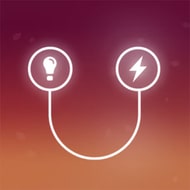
What happens when a wire fragment you’ve rotated four times still refuses to connect to the bulb two spaces away? That’s the hook of Energy, a puzzle game that strips wiring a circuit to its simplest form. The board looks solved at a glance, but one lamp stays dark, and it won’t move on until you find the fragment facing the wrong way: tap a fragment to rotate it, connect pieces into a loop, and light every bulb on the board.
| Genre | Puzzle |
| Core Mechanic | Rotate wire fragments to complete circuits |
| Objective | Light every bulb on the board |
| Design | Minimalist grid, calm soundtrack |
There’s no timer and no penalty for a wrong rotation beyond the tap it costs to undo, which is why casual players treat it as background noise between tasks rather than something demanding full focus. The puzzle is still real: the board won’t confirm a solve until every bulb is lit.
Early boards are forgiving, with one power source and a short loop connecting it to a handful of bulbs. The trouble starts once a board’s wire count grows past what you can track by eye — a fragment that looks aligned can still be one rotation off, since connection points are directional, not just visually touching.
The most common beginner mistake is tunnel vision on the bulb closest to the power source while a lamp tucked in a corner sits dark and forgotten. A level only counts as complete when every bulb is lit, so newer players often assume that corner bulb is unreachable when it just needs one fragment rotated along its own path.
The fix experienced players land on isn’t rotating faster, it’s tracing a single unlit bulb backward toward the source, checking every branch instead of just the loop that looks biggest.
Energy slowly introduces more elements and power sources as boards progress, and the moment a second source appears is a real turning point. Players who cleared earlier boards by following a single chain suddenly split their attention, and it’s common to “finish” one network while forgetting the second exists off to the side.
Once boards grow dense enough that scanning stops working, the reliable approach is finding the junction where three or four wires meet and solving outward from there instead of from the source inward. That junction almost always decides whether two or three bulbs light up correctly, so getting its rotation right first saves redoing half the board. Players chasing a quick clear rather than a relaxed one lean on this habit constantly, since it turns a chaotic board into smaller, predictable decisions.
The detail that only shows up once you’ve played for a while is what happens after a board is fully lit: the completed wiring resolves into a hidden image, something you’d never guess was there from the tangle of unlit fragments a minute earlier. The layout wasn’t arbitrary, it was tracing a picture the entire time, and you couldn’t see it until the last bulb clicked on. Completionists tend to replay earlier boards specifically to catch images they rushed past.
Connection points are directional, so a fragment can sit visually close to its neighbor without actually joining it. The usual culprit is a piece that’s a quarter-turn off, or a dead-end fragment pointed away from the bulb. Tracing that bulb’s path back to the source, fragment by fragment, finds the mismatch faster than re-rotating the whole cluster.
A second power source splits the grid into two independent networks. Both must reach full connection before the board counts as solved, so a player can light every bulb on one network and still fail because the second was never touched.
Tapping the lightbulb icon offers a nudge toward the next fragment when a board stalls out. Short of that, working backward from whichever bulb is still dark, rather than forward from the source, usually surfaces the misaligned piece faster.
Energy isn’t trying to be more than a wiring puzzle, and it doesn’t need to be — the pull is in the instant a stubborn corner bulb finally clicks on and the hidden image behind the circuit resolves into something recognizable. Anyone who’s stared at one dark bulb too long knows exactly which fragment was the problem the moment they find it.