





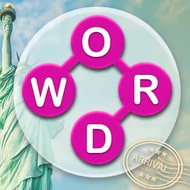
You stare at a ring of loose letters under a half-finished grid, drag a finger from tile to tile, and watch a word snap into place across two directions at once. That single connected line is the whole engine of Word City Crossed, and the first time a long word locks two blank rows at once, this one survives past the first coffee break.
| Genre | Word puzzle, connect-the-letters crossword |
| Core mechanic | Dragging a line across letters to spell words that fill a crossword grid |
| Setting | A city-by-city world tour, including Paris, New York, London, and Tokyo |
| Puzzle count | Over 2000 individual grids |
Every grid starts the same way: loose letters sit below an empty crossword shape, and the job is tracing a line from letter to letter until a real word forms. The grid fills in both directions, so one correctly placed word can lock two rows at once. There is no typing, just dragging.
What separates this game from a plain word search is that overlaps are the point. A short solved word might share a square with a longer word not yet found, and that square is meant to be read as a clue, not a coincidence.
Coins collect as each grid clears, and they matter more once letter rings grow past the opening city.
Most new players spend starting hints on the wrong squares. A hint reveals a single letter, not a whole word, so using one on a short answer wastes value that matters more on a seven-letter word blocking other answers.
Dragging too fast causes a second mistake: forming a valid but unrelated word that does not fit the grid shape. It lands in a side tray for bonus coins, which feels like progress but clears nothing, leaving beginners confused why the grid still looks empty.
The fix for both problems is reading a shared square before solving either word touching it. A confirmed letter at an intersection narrows a missing word to one or two options, and a seven-letter word may need only two before the rest becomes obvious.
Paris, the opening city, keeps letter rings short and shapes forgiving. Once every grid there clears, letter counts climb and the shapes stop being symmetrical, forcing players to hold two or three possible words in mind before dragging.
New York introduces longer answers that eat up more of the grid, and by the time London and Tokyo open, puzzles routinely ask for six or seven words from the same ring, several differing by one letter. That similarity is deliberate; it makes later cities feel harder, not just longer.
Difficulty here is overlap density, not vocabulary size, which is why players talk about grids in terms of shape rather than word list.
Clearing every grid in a city triggers a spin wheel, and the reward pool is not purely coins. Depending on the spin, players walk away with extra hints, a coin bundle, or a jigsaw piece. The randomness frustrates plenty of players, since finishing a city and landing on a small coin payout instead of hints feels like a letdown after the grind.
The jigsaw piece sits on its own screen, so a player chasing city progress can miss it stacking toward a finished image.
Players can also send spare lives or coins to others and compare progress on the city map. It is not head-to-head, since nobody solves the same grid at once, but a periodic leaderboard ranked by speed and accuracy adds a competitive edge a solo puzzle would not have.
The puzzle count sits above 2000 grids across more than twenty cities, each with themed vocabulary tied to landmarks like the ones waiting in Paris and Tokyo.
Running out of hints does not end a puzzle. Grids can still clear using the letter ring and pattern-reading, though pace slows on longer words, which is why saving hints for high-overlap squares matters most later on.
Any valid word dragged from the ring gets accepted, even without a matching blank. Extra words drop into a side tray for coins but do not fill the puzzle, so chasing them too early slows progress.
Word City Crossed ends up being less about vocabulary and more about reading a grid shape before a finger touches a letter, and once Tokyo’s overlaps appear, that habit keeps the coin count climbing.