











You open Townscaper to an empty grid of pale, gently rippling water, a small palette of colors sitting in the corner, and nothing else — no tutorial popup, no resource counter, no timer ticking down anywhere on the screen. The only decision available is where to place the first colored block, and that decision is entirely yours.
There’s no win condition and no fail state, which is part of why reviewers have repeatedly called it more of a toy than a traditional game — a description that holds up once you’ve spent an hour in it. You choose a color, click a tile on the irregular grid, and a shape appears. What that shape becomes — a plain wall, a rooftop, an archway, a set of stairs — depends entirely on which tiles around it are already filled, not on anything you explicitly choose.
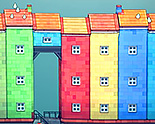
The algorithm is doing all of the architectural thinking here: it reads the pattern of filled and empty tiles surrounding your new block and picks whichever structure fits that configuration, generating everything from towering, cathedral-like spires to leaning stone bridges without you ever placing an individual wall or beam by hand. That handoff of control is the entire point — you’re steering outcomes, not drafting blueprints.
Players who spend real time in Townscaper eventually learn a few of the algorithm’s specific rules, and the clearest example is stairs. Build a foundation, place two blocks along its edge, and leave exactly one empty tile between them, and a single staircase appears in the gap. Leave two tiles instead, and you get two staircases facing each other across the space. Leave more than two, and no stairs appear at all — the gap simply reads as too wide. It’s a small, precise rule that nothing in the game explains directly, and figuring it out by trial and error is a rite of passage more than a documented tutorial.
New players often fight this system before they understand it, planting blocks in isolated clusters and getting frustrated when nothing coheres into the shapes they pictured. The buildings only start looking intentional once you build outward from a single connected mass instead of scattering blocks across the grid.
Leaving gaps of open water between clusters carves canals that the algorithm edges with quays rather than solid walls, which is how players sculpt narrow waterways instead of flat islands. Push a cluster tall and narrow enough and it starts generating soaring towers instead of squat houses; keep clusters thin and elevated and Townscaper leans toward stilted structures that read as sky-borne villages. Architecture hobbyists tend to use this to block out a fictional town’s silhouette in minutes, treating the whole toy as a fast sketching tool rather than a finished product. None of these outcomes is menu-driven — every one of them comes from the same single action of placing a colored block, which is either the most elegant part of the design or the most limiting, depending on which players you ask.
Some players find the lack of direct control liberating; others eventually want a way to force a specific building shape rather than coax one into existing, and that tension is one of the more honest things regular players say about it. Players looking for something closer to a fidget toy just enjoy watching clusters bloom into rooftops with no stakes attached, while photo-mode tinkerers spend more time adjusting the in-game lighting and camera angle around a finished town than they spent building it. None of these approaches is more correct than another, because success was never defined in the first place.
That absence of a defined goal is exactly why Townscaper keeps pulling people back — there’s always one more gap worth leaving open to see whether the algorithm turns it into a staircase, a canal, or something in between.