










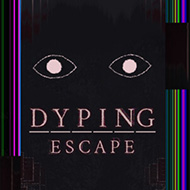
You sit down expecting a typing drill and instead a line appears that isn’t a suggestion, it’s a demand: type this, exactly, before the eyes lose patience. Miss a letter under Dyping Escape’s dictation and the screen doesn’t reset kindly, it just remembers, and the next command arrives anyway. That first exchange sets the tone for the rest of the run: you are not practicing here, you are answering to something that keeps score and doesn’t say why.
| Genre | Horror typing adventure |
| Core Mechanic | Typing exact on-screen commands under pressure |
| Session Length | Short, meant to be finished in one sitting |
| Category | Audio Games |
The opening stretch of Dyping Escape looks almost administrative. A prompt appears, you type it back, a pair of eyes on screen watches you do it, and the game moves on. There’s no health bar, no inventory, nothing to click but the keys in front of you. Players who go in expecting a jump-scare gallery are usually thrown by how quiet the first few minutes are — the eyes don’t threaten you outright, they just wait, and the waiting is doing most of the work. That restraint is deliberate; the dictation itself is the tension, not a soundtrack sting layered on top of it.
Beginners consistently make the same mistake: they treat the prompts as a speed test and blast through them, assuming faster typing means a better outcome. Dyping Escape doesn’t reward raw speed the way an ordinary lesson would. It cares whether you typed what was actually shown, capitalization and punctuation included, and it will let you know when you didn’t — sometimes in ways that don’t match what you remember doing. New players lose more time arguing with the feedback than they do actually mistyping.
The eyes never explain themselves, and that’s the part community threads keep circling back to. People arrive expecting a tutorial voice and leave describing something closer to being supervised. Once you accept that the eyes aren’t there to help you improve your words-per-minute, the rest of the run reads differently — every command becomes a small negotiation instead of a routine typing exercise.
There’s a specific moment players bring up constantly: the game tells you flatly that you are off by 0 seconds, then adds that it really hates lies. You weren’t late. The clock says you weren’t late. It accuses you anyway. That single line does more to unsettle new players than any of the visual distortion effects layered on afterward, because it breaks the one thing a typing game is supposed to be honest about — whether you did the thing correctly.
Once that trust cracks, every later prompt in Dyping Escape gets read differently. You start second-guessing a command you typed cleanly, wondering if the eyes are going to tell you otherwise regardless. Advanced players lean into this instead of fighting it; they stop trying to satisfy the timer and start typing at a pace they can defend to themselves, which turns out to matter more than raw accuracy once the cursed sections start layering commands on top of each other.
By the time you reach the stretch players refer to as the other world, the dictation has stopped resembling a lesson entirely. Words arrive out of order, commands contradict the one before them, and the eyes stop waiting between lines. It’s the clearest signal that Dyping Escape was never really about typing speed — it was building toward this specific unraveling the whole time.
Difficulty in Dyping Escape doesn’t ramp with a visible meter, it ramps through pacing, and that’s the part most walkthrough attempts skip over. Early commands leave you a beat of breathing room between one line and the next. Later ones don’t, and the game never announces the shift — you just notice, usually a few lines too late, that you’ve been typing continuously without the pause you were relying on.
Players who finish the run in one sitting talk about a specific tell: the eyes’ commands start repeating fragments of earlier lines right before a harder passage hits, almost like a warning if you know to listen for it. Missing that tell isn’t fatal, but it does mean walking into the cursed game’s harder dictation without the half-second of preparation regular players use to steady their hands.
Not everyone finds this satisfying, and it’s worth saying plainly: some players feel the ending arrives too abruptly relative to how much dread the middle section builds, and that criticism shows up often enough in community discussion to be more than a one-off complaint. It doesn’t undo what the typing-horror hook accomplishes for most of the run, but it’s a fair thing to know going in rather than discovering it cold.
Dyping Escape works because it never lets the typing feel like practice for long — the eyes turn a keyboard drill into something closer to an interrogation, and the moment they accuse you of lying about a timer you clearly beat is the moment most players stop treating it as a lesson at all. That’s the game’s actual trick: it borrows the shape of a typing tutor and spends the whole run quietly breaking your trust in it.